
Why the usa Is stronger than everyone else
South Africa and the USA have both hosted the World Cup.
YET, they were hosting two very different tournaments.
Why?
When South Africa hosted the World Cup in 2010, it was widely viewed as an opportunity. An opportunity to attract investment. An opportunity to showcase the country to the world. An opportunity to accelerate economic growth and development.
The USA is hosting the World Cup this year, but the conversation is different.
Nobody is hoping the World Cup will put the United States on the map.
Bru. The USA is the map.
Because in 2010, South Africa hosted the World Cup while dealing with:
Load shedding
State capture
GDP growth slowing
Unemployment extremely high
In 2026, USA is hosting while:
Having the world’s reserve currency
Producing roughly a quarter of global GDP
Being home to most of the world’s largest companies
Possessing enormous transport, financial, and media infrastructure
Must be nice.
But how did the USA become the kind of country that can generate billions of dollars from a month long sporting event?
The answer begins more than 400 years ago, in a struggling English colony called Jamestown.
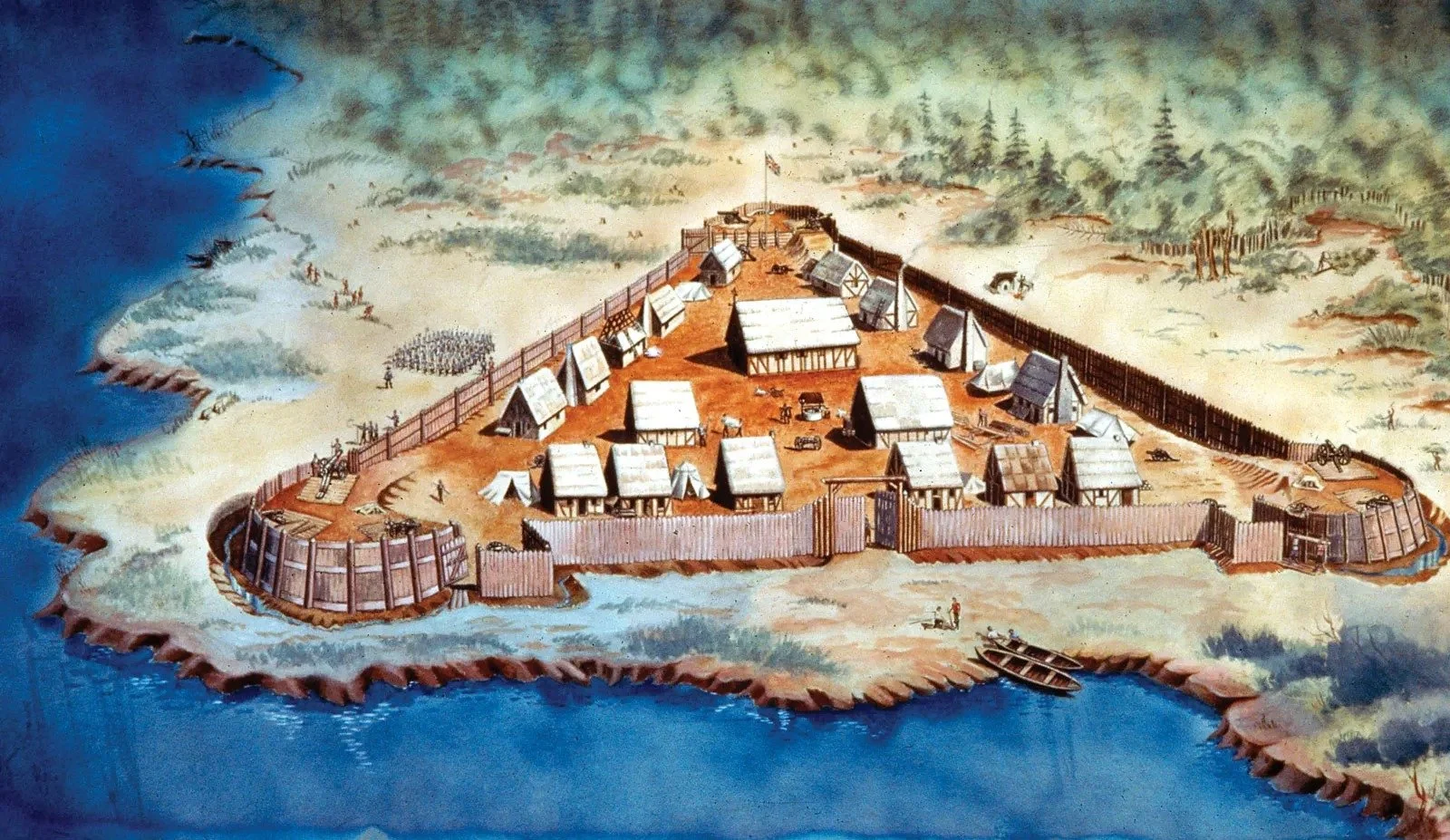
English colonisation in North America
When the English colonisers arrived in Jamestown in 1607, they found a landscape entirely different from the wealthy Aztec and Inca empires conquered by the Spanish in South America. Because the English were latecomers to European expansion, the best areas with the easiest people to exploit, were not there.
North America also had people groups that were a lot more spread out and groups like the Powhatan Confederacy were made up of smaller communities than the Inca Empire.
Because of this, the English could not control a single ruler or force a large population into labour (the fashionable way to colonise), making it difficult to rely on local people for support.
What did they have to do differently?
The English colonists had to adapt by doing the work themselves. Shem.
The Virginia Company tried to control and exploit their own people through strict laws and harsh punishments. But this failed because people could just escape into the open land or join indigenous communities.
So, forced labour proved ineffective.
The solution to this? Land and Political incentives
· Property Rights (The Headright System): The company began giving each male settler 50 acres of land, plus an additional 50 acres for each family member or servant they brought to Virginia.
· Political Rights (The General Assembly): All adult male property holders were given a say in the laws and institutions that governed the colony.
Obviously, they preferred the OG Spanish model of colonisation, but it was impossible in North America. The English had to create inclusive institutions. By this I simply mean systems that allow ordinary people to participate. Power and opportunities could not be concentrated in a small elite.
It was the only way to incentivise work and invest in building a colony that wouldn’t starve.
But that was a long time ago… how did it become the USA we know today?
It’s because they didn’t stop. The continued building institutions that rewarded individual effort and innovation. Institutions is a big fancy political and economics word, it just means “The rules of the game”. Their country just became a fairer game to play:
The Constitution
By the 1720’s all 13 colonies of the USA had similar ways of governing. There was a governor and an assembly consisting of male property holders. It was not perfect, women and people of colour were not recognised like they are today… but this was very progressive by the world standards of that time. These early colonial assemblies eventually led to form the First Continental Congress, leading directly to the drafting of the U.S. Constitution.
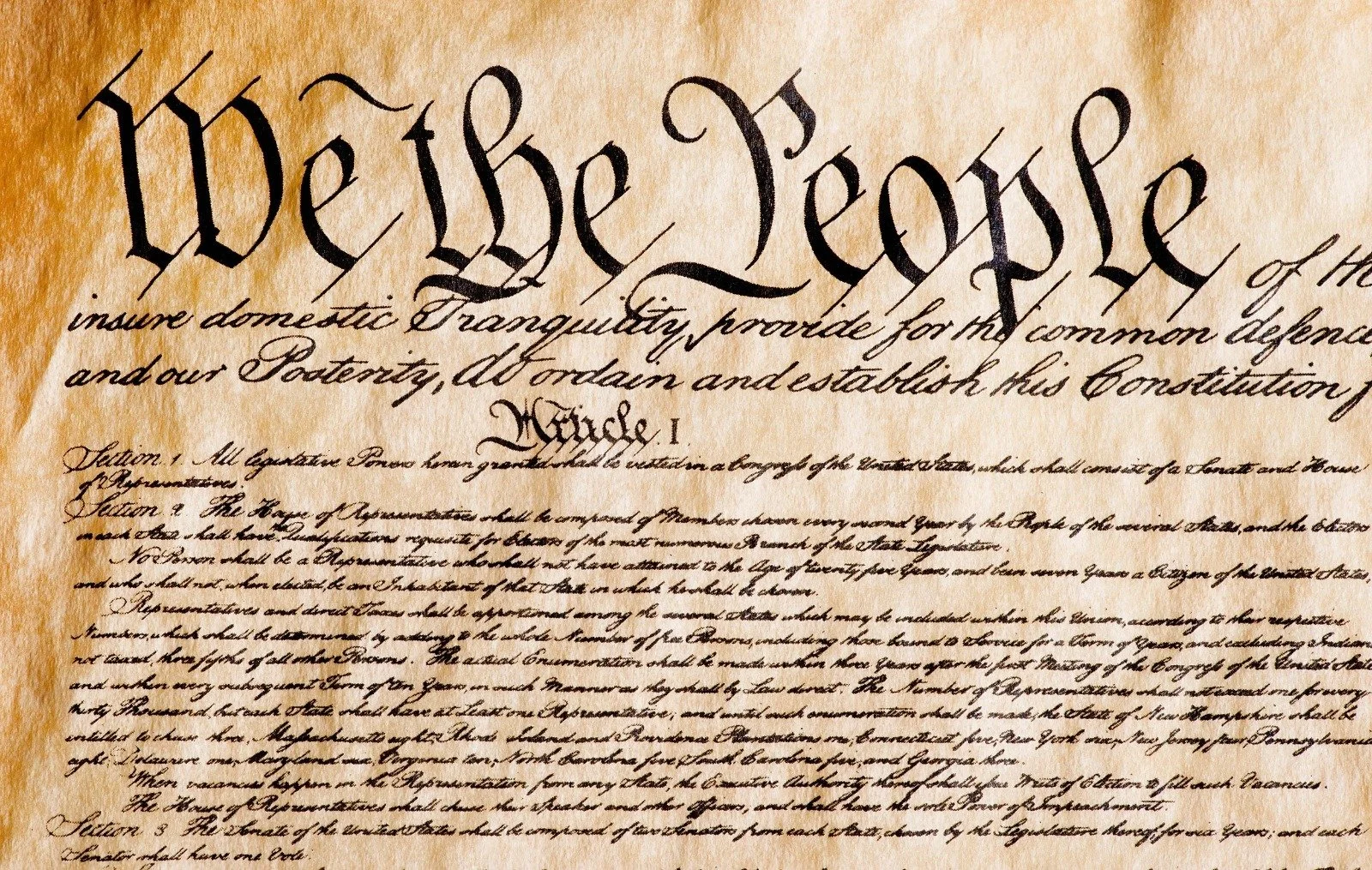
It was designed to stop too much power from ending up in the hands of one person or a small group. Instead, power was spread across different branches of government and ultimately rested with ordinary people. This gave people confidence that the rules would be applied fairly and that their property and livelihoods could not simply be taken away by those in power.
Patents
Because political power was more widely shared, economic opportunity became more widely available too. The USA developed a patent system that allowed ordinary people to protect and profit from their ideas. Innovation was not reserved for the wealthy or well connected.
Between 1820 and 1845, around 40% of patent holders had only a primary school education or less. This suggests that opportunity was available to people from many different backgrounds. Someone with a good idea did not need to be born into privilege to succeed.
Thomas Edison is a famous example. He had very little formal education, yet he was able to patent his inventions and become one of the most influential inventors in history.
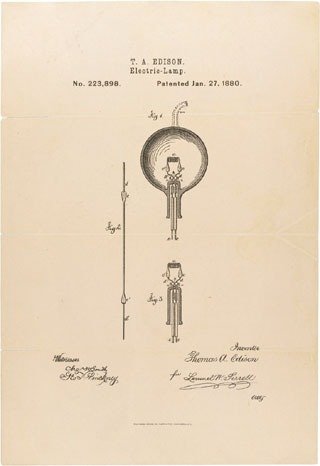
In many parts of the world, a brilliant idea stayed a brilliant idea. In the USA, a brilliant idea could become a business.
Finance
Then marked the era of increased access to finance and capital.
In 1818 there were 338 banks in operation in the US, with total assets of $160 million, by 1914 there were 27 864 banks, with total assets of $27.3 billion.
Mal.
They had a fiercely competitive banking industry that provided broad access to loans at low interest rates.
A key insight here: They had been building up this system for 200 years.
Building…
Building…
Building…
And then… BOOM. The Industrial Revolution.
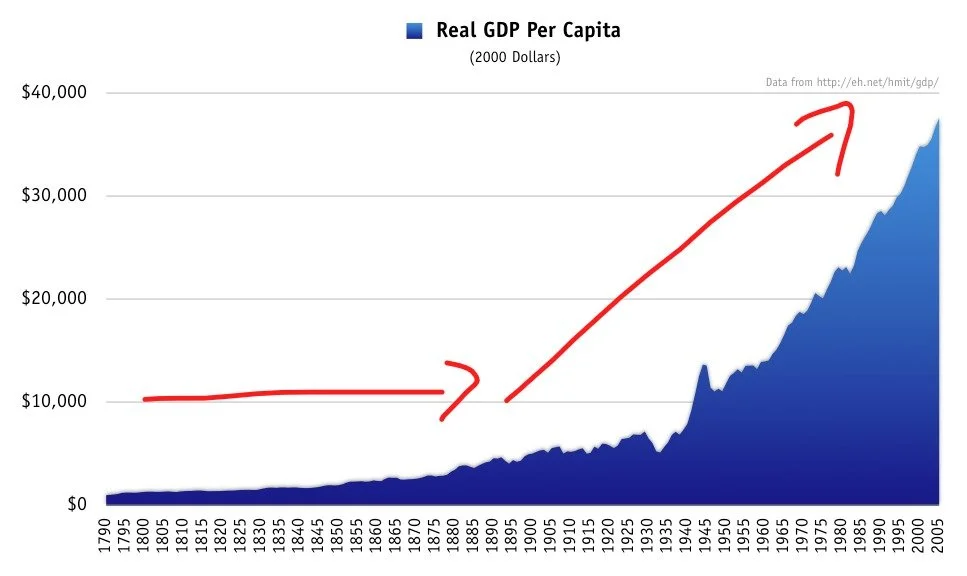
As a result. The USA was able to propel itself to the high living standards it enjoys today.
That’s the thing, when one of defining moments of human history happened, they were ready for it. It took them 200 years.
The settlers in Jamestown never saw the Industrial Revolution. The people who established the early assemblies never saw USA become a global superpower. The generation that created the foundations never enjoyed the full benefits of what they were building.
Yet they built anyway.
Perhaps that is the lesson for South Africa.
We want transformation in five years. We want economic growth in one election cycle. We want the results before we have laid the foundations.
But history suggests that prosperity doesn’t work that way.
The countries that prosper are the countries that spent generations building the institutions, habits, skills, and systems that allowed them to seize opportunities when they arrived.
The opportunity will come, history promises it will. But will we be ready for it when it arrives?
Your turn:
Be patient with yourself and what you are building.
As you can see in the story, the big boom was only a result of the 200 years of small steps.
“A race is not won on race day, it is won by every decision you made going for a run before then.”
Do the next small thing in front of you. When a big opportunity comes, you will be able to take hold of it… because you have good structures in place.
With the environment you are in, make sure it has the capacity to carry a heavier load before the load is put on it.
Most countries around the world in the 1800s, through fault of their own or others, did not have the political and economic roots in order to make use of the opportunity that was the industrial revolution.
Make sure the structures you find yourself in can handle the next ‘boom’.
Progress is to be found in the small incremental differences, not the big steps.
BUT, progress that only benefits you, is no progress at all.
Progress is not about what we accumulate, but by what kind of communities we create…
…and you’ve got a part to play. I’ll tell you about that next week.
Looking forward to changing the world with you. ❤️🌍
